

The Challenge
A budget impact model is a piece of reasoning before it is a spreadsheet. Who is eligible, what they are treated with today, what changes when a new therapy arrives, and what that does to a payer's budget over the next few years. Those are the questions worth a health economist's attention, and they are the ones a reviewer will press hardest on.
Building the workbook that expresses those choices is a different kind of work. It is careful and it is necessary, and it is also assembly: transcribing parameters, wiring the market shares, laying out the cost calculations, and checking that what comes out matches what the specification said should come out. The judgement does not live there.
None of that is impossible, and none of it takes forever. The cost is subtler. The assembly, and the upkeep every time an assumption moves, comes out of the same budget as the thinking, the testing, and the strategy. That is the trade this was built to remove.
How It's Done Today
The specification exists first, written by someone who thought carefully about the market and the population. Then someone opens that document beside an empty workbook and begins transferring it, cell by cell. Parameters are typed in and their sources noted somewhere, if there is time. Market shares are wired by hand. The published figures in the specification are recalculated to see whether the model agrees with the document it came from.
Then an assumption changes, because assumptions always change, and a good part of that work is done again. Each pass is another opportunity for a number to enter wrong and stay wrong, because the person checking is the person who built it.
What the System Does
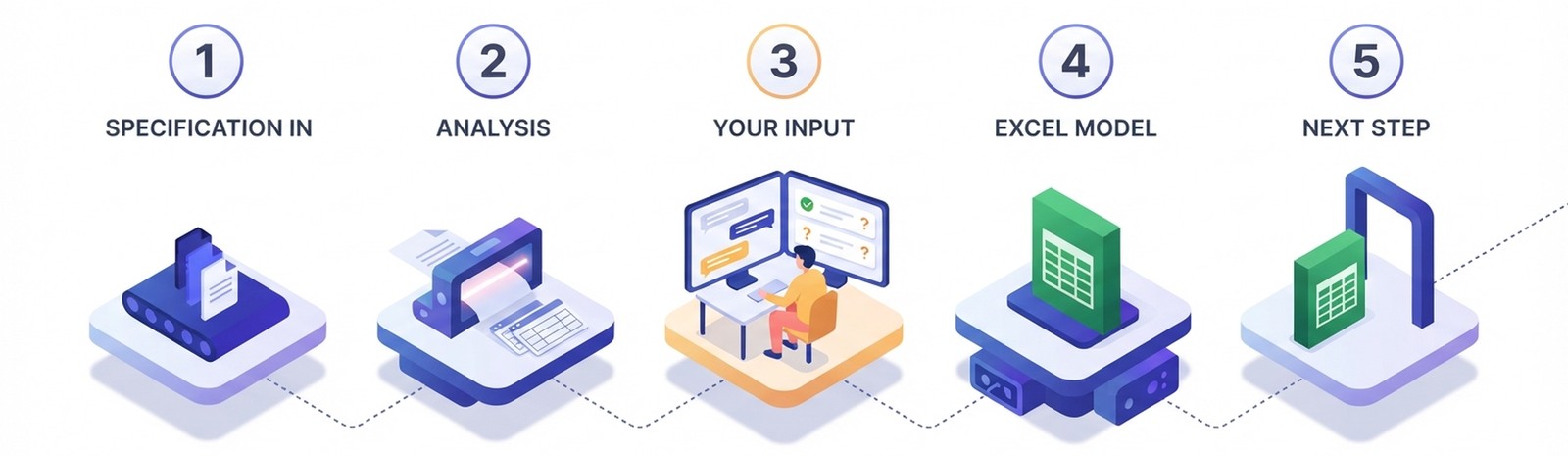
You design the model. You hand it over as the specification you already wrote, prose and tables, in PDF, Word, Markdown, or plain text. What comes back is a model in progress, and you work on it.
It reads the specification once, and reviews it critically. In the recorded demo that pass takes three minutes and eleven seconds, and it is the only time a language model touches this model. Everything after it is arithmetic. The system checks the specification against itself, and against what a budget impact model needs in order to run.
It tells you what it could not settle, worst first. Whatever the document left open, or left ambiguous, comes back as a question, ranked by how much it matters, the serious ones ahead of the minor ones. Where the specification says something the model cannot reproduce, the system quotes your own document back at you and shows the disagreement, rather than choosing for you.
It walks you through, and it never blocks you. You answer what you want to answer and leave the rest. Open questions do not withhold your model: the build action reads "Build the Excel model, N gaps recorded" and it works with items still open. Anything you leave open is recorded as a gap, and the record travels with the workbook so the next person to open it can see what was assumed.
It does the assembly. The extraction, the wiring, the arithmetic, the workbook. In the demo the market structure is visible on screen: the plan protects a multi-source generic, so it holds its share while the others give up share in proportion to what they hold. Every parameter carries the provenance of where it came from, quoted from your own document.
It checks itself against your own figures, before anything is built. A specification usually publishes figures of its own, and those figures are a test the model has to pass. In the demo, all 28 figures the specification publishes reconcile with the model up front.
Then you play with it. This is the part that separates a model you can work with from a generator you run again. In the demo the new product's first year uptake moves from 3% to 6%. The market reflows around it and the protected product does not move. In the same breath the system reports that six of those 28 published figures no longer reproduce, and it names the cause: a stated figure and the computed figure now differ by more than ten per cent, which is a disagreement with the specification rather than a data entry error. No rebuild, no waiting, and no model call. The edit and the revert are pure arithmetic. Put the number back and everything returns exactly: shares, findings, grade.
You can also question the finished model, and the answers come from the build's own artifacts. Ask for a scenario the build does not contain and it says so, then points at where you can change it yourself.
And it still gives you the model. The header still says the workbook builds clean. A grade tells you where judgement is needed. It does not hold your work hostage.
Then You Take the Spreadsheet
When you are done, you ask for it as a workbook, which is where budget impact models actually live. Real Excel with live formulas rather than pasted values. The eligibility funnel in the demo runs 1,200,000 covered lives to 18,000 diagnosed to 10,440 treated, and every step is a formula reading the rate your document stated. Change an input and the workbook recalculates. The disclosure register travels with the file.
See It Work
The recorded demo follows one specification the whole way: a three minute reading pass, the questions it comes back with, 28 published figures reconciled, an uptake assumption changed and reverted, and the Excel file that comes out.
The specification used in this demonstration is hypothetical. The therapy and its comparators are invented, and every price and rate was constructed for testing.
What It Means for You
- Your attention goes where your judgement matters. The system carries the assembly and the upkeep, so the time goes to the structure of the problem, the assumptions worth arguing about, and what the model has to be able to answer.
- It questions your specification instead of quietly filling the gaps. What the document did not settle comes back to you as a ranked question, with the relevant passage quoted, so a silent assumption never becomes a number you did not choose.
- Nothing is withheld. Open questions are recorded as gaps and the workbook still builds. A grade says where judgement is needed and it never gates your work.
- Every parameter shows its source. Provenance is quoted from your own document, so a reviewer can check the model against the specification without reading the spreadsheet backwards.
- Changes answer immediately. Edits are deterministic arithmetic. The market reflows and the reconciliation re-reports with no rebuild and no model call, so you see your action and its consequence together.
- You leave with a real workbook. Live formulas, in Excel, where budget impact models live, with the disclosure register attached.
For anyone building budget impact models for market access, in consultancies or in pharma: the model you designed, assembled for you, questioned where it should be, and handed back as a spreadsheet you can defend.